
SEO Web Design Malaysia: How to Build a Website That Ranks and Converts in 2026
A good website should not only look professional. It should also help customers find your business, understand your offer, trust your company, and contact you.
That is why SEO web design matters.
For many Malaysian businesses, the website is the first serious touchpoint before a customer sends a WhatsApp message, requests a quotation, books a consultation, or compares suppliers. If the website is slow, hard to use on mobile, poorly structured, or unclear about what the business does, it can lose both search visibility and enquiries.
SEO is often treated as something to “add later” after the website is designed. That approach usually creates more work. Search visibility depends on decisions made during website planning, content writing, UI design, technical build, and post-launch measurement.
This guide explains how to build a website that supports both rankings and conversions in 2026.
What Is SEO Web Design?
SEO web design means designing and building a website so that people and search engines can both understand it easily.
It combines:
- User experience and mobile-friendly layout.
- Clear service positioning and page structure.
- Fast loading speed and stable visual layout.
- Search-friendly content and headings.
- Internal links between related pages.
- Descriptive URLs, title tags, and meta descriptions.
- Image optimisation and useful alt text.
- Structured data where suitable.
- Conversion paths such as WhatsApp, enquiry forms, calls, and quotation requests.
In simple terms, SEO web design connects visibility with business action. The website should help Google understand the page, and help visitors decide whether to contact your company.
Why Web Design Affects SEO Ranking
Google’s SEO guidance is clear that search optimisation is not only about keywords. It is about helping search engines understand your content and helping users decide whether to visit your site.
Design affects that process in several ways.
A poorly planned website may hide important content behind unclear menus, use generic page titles, load slowly on mobile, or combine many different services into one vague page. Search engines then have less context, while visitors have fewer reasons to stay.
A well-planned website gives each important service its own clear page, uses helpful headings, links related content together, loads quickly, and gives visitors a clear next step.
For a business targeting “website design Malaysia”, this matters because the searcher usually has commercial intent. They may be comparing providers, checking credibility, reviewing portfolios, or trying to understand cost and process. The website must answer those questions quickly.
1. Start With Search Intent Before Design
Before designing the homepage or service page, define what the visitor is trying to do.
For a web design service, useful search intent may include:
- “website design Malaysia” - comparing web design providers.
- “web design company Malaysia” - looking for a suitable agency or vendor.
- “SEO web design Malaysia” - wants a website that supports rankings.
- “website redesign Malaysia” - already has an old website and needs improvement.
- “ecommerce website design Malaysia” - wants to sell online.
- “corporate website design Malaysia” - needs a professional business site.
- “web design cost Malaysia” - researching budget and scope.
Each intent may need a different page or section. A strong website does not force every visitor through the same generic message.
For example, a corporate website buyer may care about credibility, compliance, portfolio, and stakeholder approval. An ecommerce buyer may care about product catalogue structure, checkout flow, payment gateways, inventory, and performance.
Good SEO web design starts by mapping these needs before the page layout is created.
2. Build Pages Around Clear Topics
Search engines and users understand websites better when pages are organised by topic.
Instead of putting every service into one short “Our Services” page, create focused pages for important offerings. A company that provides web design, SEO, ecommerce, hosting, software development, and WhatsApp automation should not depend on one generic service page to rank for all of them.
Each important page should answer:
- What is the service?
- Who is it for?
- What problems does it solve?
- What deliverables are included?
- What is the process?
- What proof or experience supports the service?
- What questions do buyers usually ask?
- What should the visitor do next?
This makes the page more useful to visitors and gives search engines more context.
It also supports internal linking. For example, an article about SEO web design can link naturally to a Website Design Malaysia service page, a SEO and GEO service page, and related articles about enquiry generation or website redesign.
3. Make Core Web Vitals Part of the Design Brief
Website speed should not be treated as a developer-only issue at the end of the project. Many performance problems begin during design.
Oversized hero images, heavy animations, unnecessary sliders, large background videos, third-party scripts, and unstable layouts can make the website feel slow or jumpy.
Google’s Core Web Vitals focus on three practical user experience areas:
- Loading performance.
- Responsiveness.
- Visual stability.
For business websites, this translates into simple design decisions:
- Use compressed, correctly sized images.
- Avoid heavy hero media unless it has a clear purpose.
- Keep important content visible quickly on mobile.
- Reserve space for images and embedded content so the layout does not jump.
- Avoid excessive scripts and widgets.
- Make buttons and forms respond quickly.
Fast websites feel more professional. They also reduce the chance that a visitor leaves before seeing the offer.
4. Design for Mobile First, Especially in Malaysia
Many Malaysian customers browse, compare, and contact businesses from mobile phones. A website that looks good only on desktop is not enough.
Mobile-first SEO web design means:
- Important messages appear near the top of the page.
- Text is readable without zooming.
- Buttons are easy to tap.
- WhatsApp and phone CTAs are visible but do not cover content.
- Menus are simple and predictable.
- Forms are short and easy to complete.
- Images do not slow down the page.
- Service sections are easy to scan.
Mobile users are often impatient because they are searching between tasks. They may be in a meeting, on the move, or comparing suppliers quickly. The design should help them understand the business in seconds.
5. Write for Buyers, Not Only for Keywords
Keyword stuffing does not make a weak page useful.
Google’s helpful content guidance recommends content created for people, with original value, clear expertise, and enough information to help the reader achieve their goal.
For a web design service page or article, this means the content should answer real buying questions:
- What makes a website SEO-friendly?
- How does website design affect Google ranking?
- Should SEO be done before or after launch?
- What pages does a business website need?
- How does mobile speed affect enquiries?
- What should be included in a web design quotation?
- How do AI search experiences change website content planning?
The content should use natural language and practical examples. It should show real experience from building business websites, not just repeat common SEO tips.
6. Structure Content for AI Search Visibility
AI search features and answer engines are changing how people discover businesses, but the foundation is still strong SEO.
Google’s guidance for generative AI features says SEO best practices remain relevant because AI search experiences rely on Google’s core search systems and indexed web pages. It also recommends valuable, unique, well-organised content supported by relevant images and media.
For business websites, this means the website should make facts easy to retrieve:
- Clear company name, location, and service areas.
- Consistent contact and business details.
- Service pages with direct answers.
- FAQ sections based on real customer questions.
- Strong headings that describe each section.
- Schema-ready content for services, organisation details, FAQs, and breadcrumbs where appropriate.
- Original examples, case studies, process notes, and expert commentary.
This is where SEO, GEO, and AEO overlap. The goal is not to create thin pages for every keyword variation. The goal is to make the business easy to understand, verify, and recommend.
7. Use Trust Signals Throughout the Page
Search traffic is only useful if visitors trust the company enough to contact it.
For Malaysian business websites, trust signals can include:
- Years in business.
- Client logos or industries served.
- Portfolio examples.
- Testimonials or review ratings.
- Certifications, awards, or partner status.
- Real company information.
- Clear contact details.
- Project process and handover method.
- Privacy policy and terms.
- Secure HTTPS.
Trust should not be hidden on a separate About page. It should appear near the sections where visitors make decisions.
For example, a web design service page can show proof near the first CTA, portfolio examples near the service explanation, and process details before the quotation request.
8. Make Conversion Paths Obvious
SEO brings visitors to the website. Conversion design turns those visitors into enquiries.
A website should make the next step obvious:
- Request a website design quotation.
- WhatsApp the team.
- Book a consultation.
- View portfolio.
- Check service scope.
- Send project requirements.
For many Malaysian SMEs, WhatsApp is a practical conversion channel because buyers want fast answers. But WhatsApp buttons should be implemented carefully. They should be visible without blocking content, and their clicks should be tracked where possible.
Forms should also be short. Ask only for the information needed to start the conversation. A long form may qualify leads, but it can also reduce submissions if used too early.
9. Optimise Images for Search and Speed
Images help visitors understand quality, style, and credibility. They can also support search visibility when used properly.
Google recommends using high-quality images near relevant text and adding descriptive alt text. For web design articles, this means the image should not be a random stock photo. It should support the topic.
Good image practices include:
- Use a relevant cover image that reflects website design, performance, mobile UX, and SEO structure.
- Compress images before publishing.
- Use descriptive filenames.
- Add alt text that describes the image in context.
- Place images near related sections.
- Avoid text-heavy images that are hard to read on mobile.
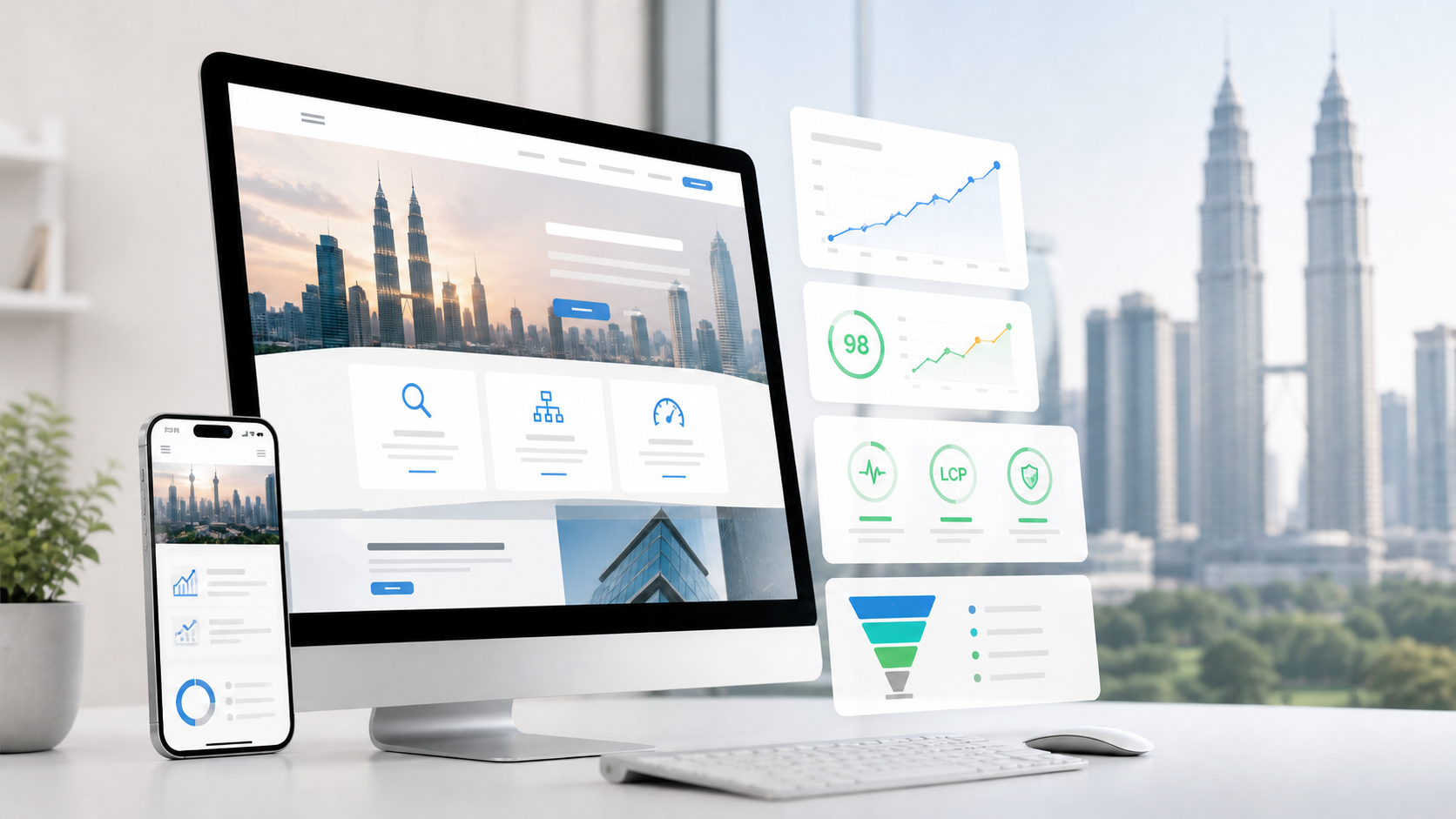
For this article, a strong cover image could show a modern business website interface with SEO structure, mobile preview, speed indicators, and search visibility elements. The image should feel like a professional digital strategy visual, not a generic laptop photo.
10. Track Results After Launch
SEO web design does not end when the website goes live.
After launch, track:
- Google Search Console impressions and clicks.
- Ranking movement for target service queries.
- Core Web Vitals and page speed.
- Organic traffic by page.
- WhatsApp clicks, call clicks, and form submissions.
- Conversion rate by landing page.
- Pages that attract traffic but do not generate enquiries.
This data shows whether the website has a visibility problem, a conversion problem, or both.
For example, if a service page gets impressions but few clicks, the title and meta description may need improvement. If the page gets visits but no enquiries, the offer, proof, CTA, or form may be weak. If the page loads slowly on mobile, performance should be fixed before spending more on campaigns.
SEO Web Design Checklist for Malaysian Businesses
Before launching a new business website, check the following:
- Does each important service have a focused page?
- Does the homepage explain what the business does within a few seconds?
- Are title tags and meta descriptions unique and clear?
- Are headings written for both users and search context?
- Is the website fast on mobile?
- Are images compressed and properly sized?
- Are important pages internally linked?
- Are CTAs visible and easy to use?
- Is WhatsApp or enquiry tracking set up?
- Are company details and trust signals clear?
- Are FAQs based on real buyer questions?
- Is Search Console installed?
- Are analytics and conversion events configured?
- Is the website ready for future content updates?
Final Thoughts
SEO web design is not about choosing between a beautiful website and a search-friendly website. A strong business website needs both.
The best websites are clear, fast, useful, technically sound, and built around the questions customers already have. They help Google understand the content, help AI search systems retrieve accurate facts, and help visitors decide whether the company is the right fit.
For Malaysian businesses planning a new website or redesign, SEO should be part of the design brief from the start. It affects page structure, content, performance, mobile experience, trust signals, and conversion paths.
If you are planning an SEO-friendly business website, Xantec can help with website design Malaysia, content structure, technical SEO, GEO/AEO readiness, and post-launch optimisation.
Suggested FAQ
What is SEO web design?
SEO web design is the practice of designing and building a website so search engines can understand it and users can easily take action. It includes site structure, content, speed, mobile usability, internal links, image optimisation, and conversion design.
Does website design affect Google ranking?
Yes. Website design can affect search visibility through page experience, mobile usability, speed, content structure, internal linking, and how easily users and search engines understand the page.
Should SEO be done before or after website design?
SEO should be planned before design starts. Keyword intent, page structure, headings, content requirements, URL planning, internal links, and performance goals should guide the design brief.
What makes a website SEO-friendly?
An SEO-friendly website has clear pages for important services, helpful content, fast loading speed, mobile-friendly layout, descriptive titles and meta descriptions, crawlable structure, optimised images, internal links, and measurable conversion paths.
How can Malaysian SMEs improve website enquiries?
Malaysian SMEs can improve enquiries by clarifying their offer, adding trust signals, creating focused service pages, improving mobile speed, using strong CTAs, adding WhatsApp or enquiry tracking, and publishing useful content that matches buyer intent.