
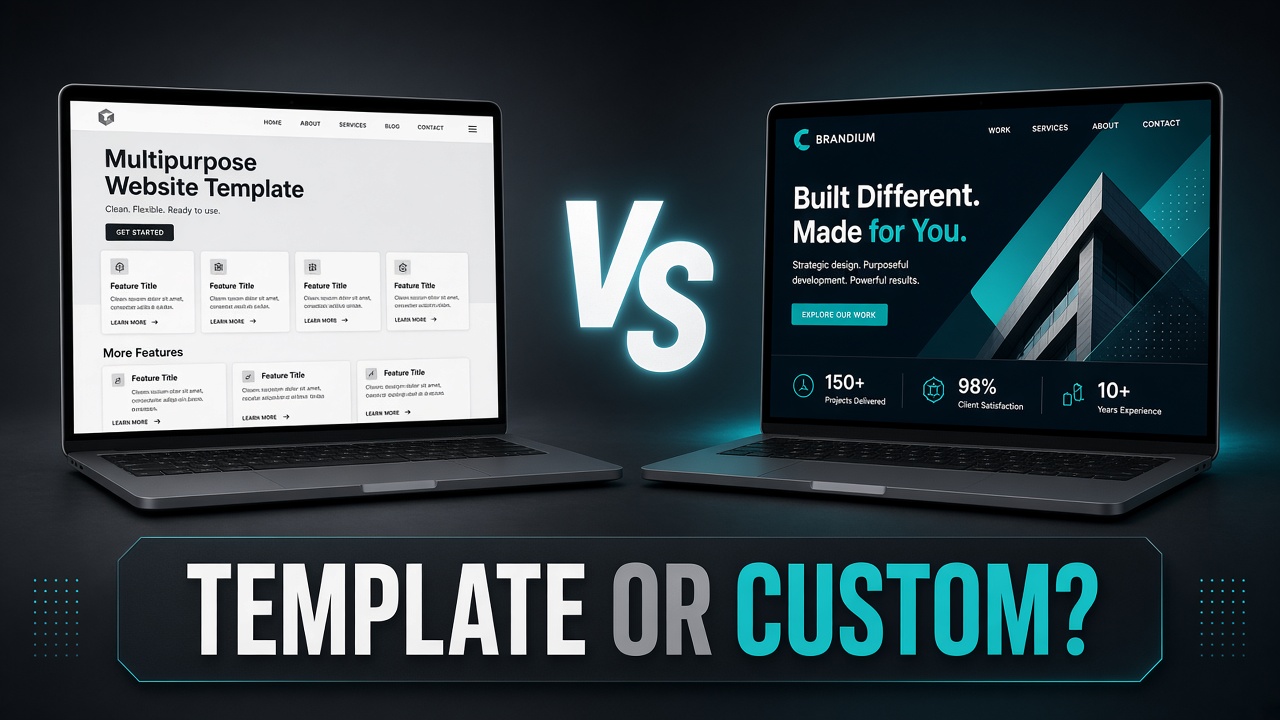
Template website vs custom website is one of the most common briefing debates in Malaysia. Templates are not “bad,” and custom is not automatically “better.” Fit depends on differentiation, conversion complexity, and growth plans.
Related: web design Malaysia · ecommerce · MagicBuild
Quick Answer
| Lean template if… | Lean custom if… |
|---|---|
| Needs are standard brochure pages | Your offer, UX, or ops are non-standard |
| Brand can share a common look with peers | Uniqueness and conversion paths are competitive advantages |
| Budget and timeline are tightly capped | Multi-language SEO, complex IA, or integrations are required |
| You accept theme constraints | Ecommerce rules, portals, or custom workflows matter |
What “Template” Means Here
A template (theme or marketplace kit) gives:
- Pre-built sections and components
- Faster visual assembly
- Lower design hours
You still need content, hosting, and maintenance. “Template” does not mean “zero work.”
What “Custom” Means Here
Custom does not always mean drawing every icon from scratch. It means:
- Layouts and components designed for your content and journeys
- IA matched to how Malaysian buyers research you
- Flexibility for future modules without fighting a rigid theme
- Design system consistency across campaigns and languages
See our approach on web design Malaysia.
Side-by-Side Decision Factors
1. Differentiation
If five competitors use the same theme demo, visitors feel déjà vu. Templates are fine when trust comes from certifications and service—not visual novelty.
2. Conversion design
Templates optimise for generality. Custom paths win for RFQ flows, multi-step services, or industry-specific proof.
3. SEO and structure
Themes can be SEO-capable. Custom (or heavily adapted) builds make it easier to control heading hierarchy, landing clusters, and entity pages—especially with SEO/GEO partners.
4. Ecommerce and rules
Catalogue filters, SST display, B2B pricing, and ERP sync often outgrow off-the-shelf theme assumptions. Scope via ecommerce web design when transactions are core.
5. Cost over three years
Templates save month one. Fighting theme limits, buying child-theme patches, and redesigning later can erase savings. Custom costs more up front when the roadmap is clear.
Middle Ground Options
- Template + professional customisation — keep a solid base, restyle critical pages.
- Design system on a flexible CMS — custom components without reinventing hosting.
- MagicBuild — packaged delivery when speed and clear tiers matter more than fully bespoke art direction.
Questions to Ask Before You Choose
- Which pages must look unlike our competitors?
- What integrations are non-negotiable in year one?
- Who owns the theme licence and child theme?
- How painful is a redesign if we outgrow this kit?
Next Step
Bring your competitor URLs and must-have journeys to a consultation. We will recommend template-led, MagicBuild, or full custom work based on evidence—not preference alone.