
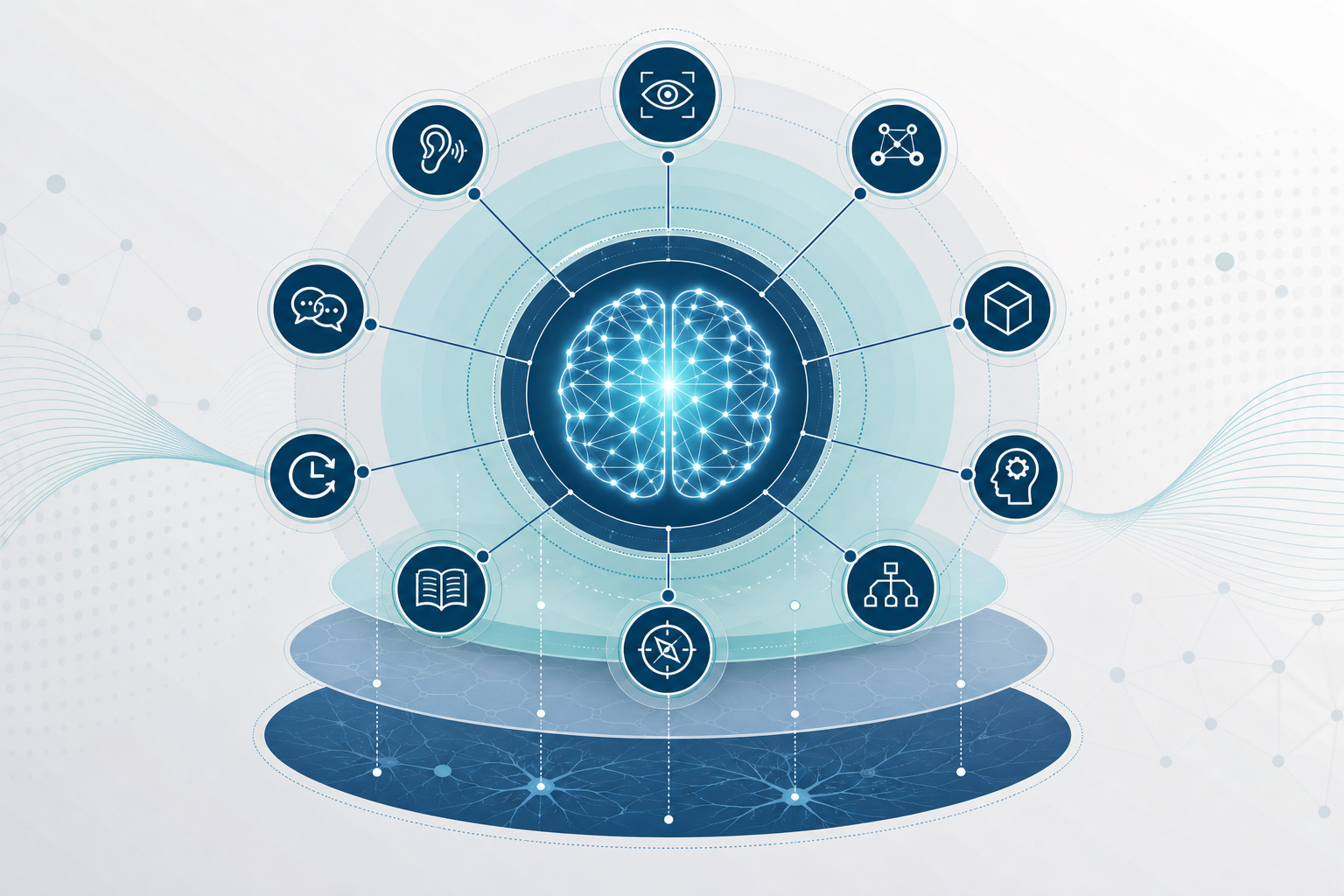
Summary of: Measuring progress toward AGI: A cognitive framework by Google DeepMind (17 Mar 2026). Read the full paper (PDF) for the complete taxonomy and methodology.
Artificial General Intelligence (AGI) could accelerate science and help solve large-scale problems, but progress is hard to judge without empirical tools for general intelligence. Google DeepMind argues that cognitive science is one important piece of that puzzle—and has published a framework plus a community challenge to turn theory into benchmarks.
Why a cognitive lens?
Instead of a single benchmark score, the approach deconstructs “general intelligence” into abilities studied in psychology, neuroscience, and cognitive science. That makes it easier to see where a model is strong or weak, not just whether it passes one test.
Ten cognitive abilities
The taxonomy highlights 10 abilities hypothesized to matter for general intelligence in AI systems:
- Perception — extracting and processing sensory information from the environment
- Generation — producing outputs such as text, speech, and actions
- Attention — focusing cognitive resources on what matters
- Learning — acquiring new knowledge through experience and instruction
- Memory — storing and retrieving information over time
- Reasoning — drawing valid conclusions through logical inference
- Metacognition — monitoring one’s own cognitive processes
- Executive functions — planning, inhibition, and cognitive flexibility
- Problem solving — finding effective solutions in specific domains
- Social cognition — interpreting social information and responding appropriately
How systems would be evaluated
The proposed three-stage protocol compares AI performance to humans on the same tasks:
- Benchmark AI across a broad suite of tasks per ability, using held-out test sets to limit data contamination.
- Collect human baselines from a demographically representative adult sample on those same tasks.
- Map each system relative to the distribution of human performance in each ability.
That human-relative mapping is the core idea: progress toward AGI becomes measurable along multiple cognitive dimensions, not a single leaderboard.
From framework to practice: Kaggle hackathon
Defining abilities is only a first step. DeepMind and Kaggle launched Measuring progress toward AGI: Cognitive abilities, inviting the community to design evaluations where gaps are largest:
- Learning
- Metacognition
- Attention
- Executive functions
- Social cognition
Participants can use Kaggle Community Benchmarks to test evaluations against frontier models. The prize pool is $200,000 (track awards plus grand prizes); submissions ran 17 Mar – 16 Apr 2026, with results announced 1 Jun 2026.
Why this matters for product teams
For businesses building or adopting AI—custom software, agents, or enterprise automation—this framework is a reminder that “capable” is multidimensional. A model that excels at generation may still lag on learning, metacognition, or social cognition. Structured evaluation aligned to human baselines is increasingly relevant for governance, procurement, and roadmap planning, especially as regulators and enterprises ask for evidence beyond demo-quality outputs. Teams exploring applied AI in Malaysia can also review our AI solutions.
Source: Original article on Google’s blog · Research paper (PDF) · Kaggle competition
This page is an editorial summary for our readers and is not affiliated with or endorsed by Google or Google DeepMind.